Prayer time calculation methods are the reason two apps on the same phone can show Fajr twenty minutes apart. Neither app is broken. Each one is following a published set of rules for turning the movement of the sun into clock times, and those rules differ in a few small numbers. Once you know what those numbers mean, the settings screen of any prayer times app stops being a mystery, and you can choose with confidence.
This guide explains what each prayer time is in terms of the sun, what the Quran and the classical tafsir say about the times of prayer, the four methods most apps offer (Umm al-Qura, Muslim World League, Egyptian General Authority and ISNA), the standard and Hanafi settings for Asr, what happens at high latitudes, and how to decide. The religious parts come only from the Quran and from al-Tafsir al-Muyassar, Ibn Kathir, al-Tabari and al-Sa'di, each named where it is used. The astronomy is standard and you can check it anywhere. Which method is best for your city is a matter for the scholars and authorities where you live, and we do not pretend to rule on it.
What the Quran says about the times of prayer
The Quran makes the times of prayer part of the prayer itself. In Surah an-Nisa, Allah says the prayer is “decreed upon the believers a decree of specified times”
(Quran 4:103):
﴿فَإِذَا قَضَيْتُمُ ٱلصَّلَوٰةَ فَٱذْكُرُوا۟ ٱللَّهَ قِيَـٰمًا وَقُعُودًا وَعَلَىٰ جُنُوبِكُمْ ۚ فَإِذَا ٱطْمَأْنَنتُمْ فَأَقِيمُوا۟ ٱلصَّلَوٰةَ ۚ إِنَّ ٱلصَّلَوٰةَ كَانَتْ عَلَى ٱلْمُؤْمِنِينَ كِتَـٰبًا مَّوْقُوتًا ١٠٣﴾(103) And when you have completed the prayer, remember Allāh standing, sitting, or [lying] on your sides. But when you become secure, re-establish [regular] prayer. Indeed, prayer has been decreed upon the believers a decree of specified times.
Al-Tafsir al-Muyassar explains that the prayer is obligatory in times known in the Sharia. Ibn Kathir reports from the early scholars that "kitaban mawqutan" means obligatory, and adds an early comparison: the prayer has a fixed time just as the Hajj has a fixed time. He also cites Zayd ibn Aslam, who said it comes in instalments: each time one time passes, the next one comes. Al-Sa'di draws the practical point: the prayer has a time without which it is not valid, and these are the times that Muslims young and old, learned and unlearned, have known and practised, taken from the Prophet ﷺ.
The clearest single ayah about the daily timetable is in Surah al-Isra:
﴿أَقِمِ ٱلصَّلَوٰةَ لِدُلُوكِ ٱلشَّمْسِ إِلَىٰ غَسَقِ ٱلَّيْلِ وَقُرْءَانَ ٱلْفَجْرِ ۖ إِنَّ قُرْءَانَ ٱلْفَجْرِ كَانَ مَشْهُودًا ٧٨﴾(78) Establish prayer at the decline of the sun [from its meridian] until the darkness of the night and [also] the Qur’ān [i.e., recitation] of dawn. Indeed, the recitation of dawn is ever witnessed.
Al-Sa'di explains it this way: "the decline of the sun" is its turning toward the western horizon after midday, which includes Dhuhr and Asr; "the darkness of the night" includes Maghrib and Isha; and "the Qur'an of dawn" is the Fajr prayer, named after its recitation because it is recited at length. So, he says, this ayah mentions the times of all five obligatory prayers. Al-Muyassar gives the same reading. Ibn Kathir notes that the early scholars had two views on the word "duluk", the setting of the sun or its decline from the meridian, and that al-Tabari preferred the decline from the meridian. Al-Tabari explains why: in the language of the Arabs, "duluk" means inclining. Ibn Kathir then adds that the details of each time were established by the Sunnah through mass transmission, in words and in practice, and that this is what Muslims act on today, received generation after generation.
Two more ayat describe the same day from its edges:
﴿وَأَقِمِ ٱلصَّلَوٰةَ طَرَفَىِ ٱلنَّهَارِ وَزُلَفًا مِّنَ ٱلَّيْلِ ۚ إِنَّ ٱلْحَسَنَـٰتِ يُذْهِبْنَ ٱلسَّيِّـَٔاتِ ۚ ذَٰلِكَ ذِكْرَىٰ لِلذَّٰكِرِينَ ١١٤﴾(114) And establish prayer at the two ends of the day and at the approach of the night. Indeed, good deeds do away with misdeeds. That is a reminder for those who remember.
Al-Sa'di explains that "the two ends of the day" include Fajr at the beginning and Dhuhr and Asr at the end, and "the approach of the night" includes Maghrib and Isha. In Surah Taha the Quran speaks of glorifying Allah “before the rising of the sun and before its setting”
(Quran 20:130), which al-Muyassar explains as the Fajr prayer and the Asr prayer.
Why the sun is the clock
The Quran tells us that the sun and moon were made to be counted by. Allah says “The sun and the moon [move] by precise calculation”
(Quran 55:5), and in Surah al-An'am:
﴿فَالِقُ ٱلْإِصْبَاحِ وَجَعَلَ ٱلَّيْلَ سَكَنًا وَٱلشَّمْسَ وَٱلْقَمَرَ حُسْبَانًا ۚ ذَٰلِكَ تَقْدِيرُ ٱلْعَزِيزِ ٱلْعَلِيمِ ٩٦﴾(96) [He is] the cleaver of daybreak and has made the night for rest and the sun and moon for calculation. That is the determination of the Exalted in Might, the Knowing.
Al-Sa'di's comment on this ayah could be the motto of every prayer times app: by the sun and the moon, times and seasons are known, and so the times of acts of worship are regulated, along with the terms of dealings between people. Ibn Kathir adds that the sun and moon each have stations they pass through in summer and winter, and that this is why night and day grow longer and shorter. That single sentence is the reason your prayer times change every day and are different in every city: the sun's path across your sky shifts with the seasons and with your latitude.
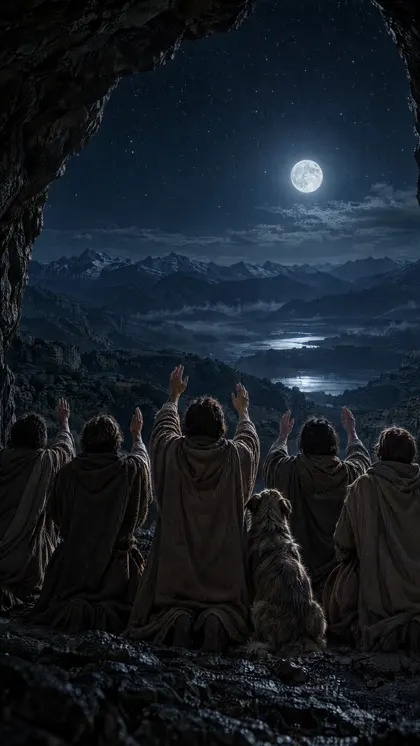
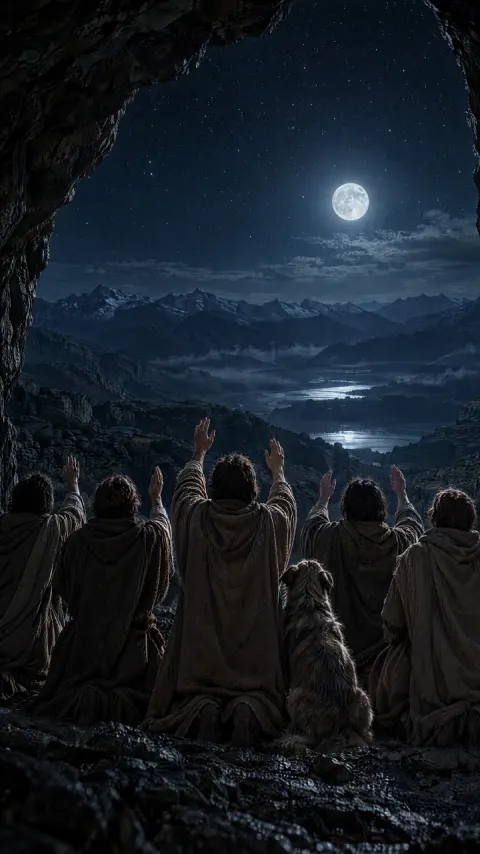
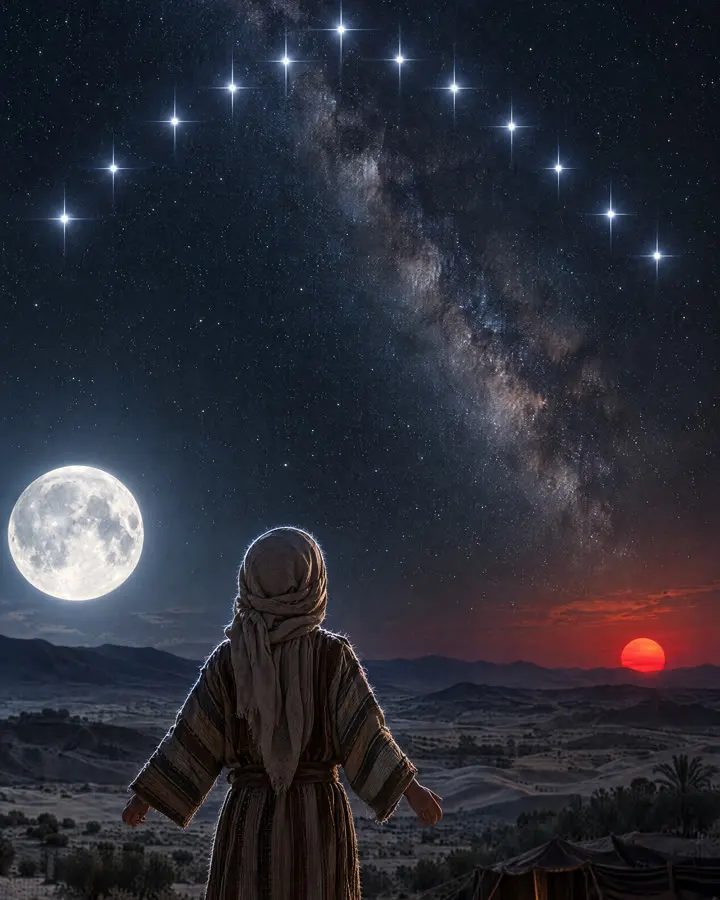
The picture at the top of this page is from the QASAS story of Yusuf's dream, in which he saw “eleven stars and the sun and the moon”
(Quran 12:4). It is a good reminder that the same sky that tells the time of prayer is full of signs.
 Watch this story in QASASYusuf's DreamEleven stars, the sun and the moon bowed to him.Open on Google Play →
The five prayer times in terms of the sun
Every calculation method, without exception, starts from the same astronomy: your latitude, your longitude, your time zone and the date. From these it works out where the sun is at each moment. What each method adds is a small number of rules for the moments that cannot be read directly from sunrise and sunset.
| Prayer | When it begins, in terms of the sun | Does the method change it? |
|---|---|---|
| Fajr | Dawn: the first light along the horizon while the sun is still well below it | Yes: the Fajr angle |
| Sunrise | The upper edge of the sun appears on the horizon (end of Fajr time) | No |
| Dhuhr | Just after the sun passes its highest point (solar noon) and starts to decline | No |
| Asr | When shadows reach a set length after noon | Only the Asr setting (standard or Hanafi) |
| Maghrib | Sunset: the upper edge of the sun disappears | No (in the four common methods) |
| Isha | The twilight glow after sunset has gone | Yes: the Isha angle or a fixed interval |
Dhuhr is the easiest. Solar noon is the moment the sun crosses your meridian, and it is calculated from your longitude and the date. It is almost never 12:00 on the clock, because time zones are wide and the earth's orbit is not a perfect circle.
Maghrib is sunset. Calculators define it as the moment the top of the sun's disc touches the horizon, which is when its centre is about 0.83° below it, once the bending of light by the atmosphere is counted. All four common methods agree on this.
Fajr and Isha are the hard ones, because they depend on twilight, and twilight fades gradually. Here is where the methods part ways.
Fajr and Isha: what the "angle" means
When an app says "Fajr angle 18°", it means: Fajr begins when the centre of the sun is 18 degrees below the horizon, before sunrise. At that depth, the first light of the coming day starts to show along the eastern horizon. Isha works the same way in the evening: it begins when the sun has sunk far enough below the western horizon that the twilight glow has gone.
The Quran describes the start of dawn in the ayah on fasting, which allows eating and drinking “until the white thread of dawn becomes distinct to you from the black thread [of night]”
(Quran 2:187). Al-Tafsir al-Muyassar explains this as the light of morning becoming distinct from the blackness of night, with the appearance of al-fajr al-sadiq, the true dawn. Ibn Kathir explains that the two threads are the whiteness of day and the blackness of night, and under the same ayah he cites reports, including one in Sahih Muslim, that distinguish a column of light rising up the sky from the dawn that spreads across the horizon. It is the dawn spread along the horizon that begins the time of Fajr. The Fajr angle is the astronomers' attempt to fix that moment as a number.
For Isha, the Quran swears by the evening twilight: “So I swear by the twilight glow”
(Quran 84:16).
﴿فَلَآ أُقْسِمُ بِٱلشَّفَقِ ١٦ وَٱلَّيْلِ وَمَا وَسَقَ ١٧﴾(16) So I swear by the twilight glow (17) And [by] the night and what it envelops
Al-Muyassar explains the "shafaq" here as the redness of the horizon at sunset, and al-Sa'di as the remainder of the sun's light that opens the night. Ibn Kathir reports that most of the early authorities said the shafaq is the redness, that one report says it is the whiteness, and that the linguists al-Khalil and al-Jawhari defined it as the remaining light and redness after sunset until close to the time of Isha. He cites a hadith in Sahih Muslim that the time of Maghrib lasts as long as the shafaq has not disappeared. Al-Tabari writes that the shafaq by which Isha becomes due is, in his view, the redness. This old discussion, red glow or white glow, is one reason methods choose slightly different Isha angles: the white glow lingers longer than the red.
A rough sense of scale helps. Near the equator around the equinoxes the sun sinks about one degree every four minutes, so 18° is roughly 72 minutes. Further from the equator the sun sets at a slant and moves down more slowly, so the same angle takes longer, and a three-degree difference between two methods can mean fifteen or twenty minutes, or much more in summer.
The four main methods compared
These are the four methods offered in QASAS, and they are among the most widely used in the world. The numbers are the published parameters used by the open-source Adhan library that many apps, QASAS included, rely on.
| Method | Fajr | Isha | Where it is commonly used |
|---|---|---|---|
| Umm al-Qura University, Makkah | 18.5° | 90 minutes after Maghrib | Saudi Arabia and the Arabian Peninsula |
| Muslim World League (MWL) | 18° | 17° | Europe, the Far East, parts of Africa and the Americas |
| Egyptian General Authority of Survey | 19.5° | 17.5° | Egypt and much of North Africa and the Levant |
| ISNA (Islamic Society of North America) | 15° | 15° | North America |
Umm al-Qura is the official calendar of Saudi Arabia. Its Fajr uses an 18.5° angle, but its Isha is not an angle at all: it is a fixed interval of 90 minutes after Maghrib. That makes Isha easy to predict, and in the latitudes of the Arabian Peninsula it sits close to the end of twilight all year. The interval does not stretch with the seasons the way twilight does, which is why it is less suited to places far from the tropics.
Muslim World League uses 18° for Fajr, the classic astronomical definition of the end of night, and 17° for Isha. It is the default in many calculators and a common choice in Europe.
Egyptian General Authority of Survey uses the deepest Fajr angle of the four, 19.5°, so its Fajr is the earliest, and 17.5° for Isha. It is the standard in Egypt and widely used across North Africa.
ISNA uses 15° for both. A shallower angle means a later Fajr and an earlier Isha. It was adopted in North America, where at many latitudes an 18° Fajr comes very early in summer.
Asr: standard or Hanafi
Asr is set by shadows, not by an angle below the horizon. Every method has a second setting for it, often called "Asr juristic method" or simply "Hanafi Asr".
- Standard (Shafi'i, Maliki, Hanbali): Asr begins when the shadow of an upright object equals its own length, plus the length of the shadow it had at noon.
- Hanafi: Asr begins when the shadow equals twice the object's length, plus the noon shadow.
The Hanafi setting always gives a later Asr, often by half an hour to an hour or more, depending on your latitude and the season. Neither setting changes Fajr, Dhuhr, Maghrib or Isha. This is a difference between schools of fiqh, not between calculation methods, so it is a separate switch. If you follow the Hanafi school, or your local mosque prays Asr at the later time, turn the Hanafi switch on; otherwise leave it off. The Quran singles out the middle prayer in “Maintain with care the [obligatory] prayers and [in particular] the middle [i.e., ʿaṣr] prayer”
(Quran 2:238), and al-Muyassar and al-Sa'di both identify it as Asr, which is a good reason to set it carefully.
Why your app and your mosque may disagree
If your app's times do not match your mosque's printed timetable, one of these is almost always the reason:
- A different method. The mosque uses, say, the Egyptian method and your app is set to ISNA. Fajr can differ by many minutes.
- A different Asr setting. One uses Hanafi Asr, the other standard.
- A different location. Your app may be using a city centre or a city you chose, not your exact position. Over a large city this changes times by a minute or two.
- Safety margins. Many printed timetables add a few minutes to Fajr, Maghrib or other times as precaution, or round to the nearest five minutes.
- Local rules. Some countries and communities use their own adjusted calendar or follow observed twilight.
- Iqamah versus adhan. A mosque timetable often lists the time of congregation (iqamah), which is later than the start of the time.
The fix is simple: ask your mosque which method and Asr setting they use and set your app to match. For praying in congregation, the mosque's iqamah time is what counts anyway.
Prayer times at high latitudes
Above about 48.5° north or south, around midsummer, the sun never sinks 18° below the horizon. Twilight lasts all night, so by a strict reading of the angle there is no moment for Isha to begin or Fajr to start. With a 15° angle the problem begins a little further north, at about 51.5°. Cities such as Paris, London, Berlin, Amsterdam and Stockholm all meet this in summer.
Calculators handle this with a high-latitude rule. The common ones are: Fajr no earlier than the middle of the night and Isha no later than it; or the night divided into sevenths, with Isha no later than the end of the first seventh and Fajr no earlier than the start of the last seventh; or a portion of the night based on the angle. These are approximations chosen by scholars and astronomers to keep the times practical. In these countries, local Islamic councils usually publish a recommended timetable, and following it is the safest choice.
How to choose the right method
- Ask your local mosque or the official authority in your country which method and which Asr setting they use. This is the best answer, because it keeps you praying with your community.
- If you cannot ask, use the method most common in your region: Umm al-Qura in Saudi Arabia and the Gulf, the Egyptian method in Egypt and much of North Africa, ISNA in North America, and the Muslim World League in Europe and much of the rest of the world.
- Set Asr to Hanafi only if you follow the Hanafi school or your mosque does.
- At high latitudes, prefer the timetable of your local council over any app's default.
- When the time is close, do not wait until the last minute of a time or pray in the first minute of one. A few minutes of margin protects your prayer from small differences between methods.
A quick summary table
| Question | Short answer |
|---|---|
| What changes between methods? | Mostly Fajr and Isha; Dhuhr, sunrise and Maghrib stay the same |
| Earliest Fajr of the four? | Egyptian (19.5°) |
| Latest Fajr of the four? | ISNA (15°) |
| Fixed Isha interval? | Umm al-Qura (90 minutes after Maghrib) |
| Why is my Asr an hour later? | The Hanafi Asr setting is on |
| Which is "correct"? | The one your local mosque or authority uses |
Prayer times in the QASAS app
QASAS is a free Islamic app with no ads, no account and no tracking, and its prayer times are calculated entirely on your phone. It offers the four methods described here, Umm al-Qura (the default), Muslim World League, Egyptian General Authority and ISNA, with a separate Hanafi Asr switch. It uses your phone's location, or a city you choose from a list if you prefer not to share location, and a chosen city keeps its own time zone. You can turn on the adhan for each prayer separately, choose a voice (classic, calm, traditional or short, or a simple beep or silent), add a reminder fifteen minutes before each prayer, and put a prayer times widget on your home screen. The same app has a qibla compass (see our guide on how to find the qibla direction), nearby mosques, a 3D tasbih, adhkar, and a Friday reminder to read al-Kahf, which we explain in reading Surah al-Kahf on Friday.
At its heart it is a Quran stories app: cinematic stories of the prophets that you can watch and read page by page, with the exact ayat, tafsir and a short quiz, plus a full mushaf with tafsir. If the picture at the top of this page caught your eye, the full story of Prophet Yusuf begins with that dream. QASAS is live on Google Play for Android; the iPhone version is coming soon.
Frequently asked questions
What is the most accurate prayer time calculation method?
There is no single most accurate method for the whole world. Each one fixes dawn and the end of twilight with slightly different angles, and each was chosen for a region. The best method for you is the one your local mosque or official Islamic authority uses.
What is the difference between Umm al-Qura and the Muslim World League?
Umm al-Qura uses an 18.5° angle for Fajr and sets Isha at a fixed 90 minutes after Maghrib. The Muslim World League uses 18° for Fajr and an angle of 17° for Isha, so its Isha moves with the seasons. Dhuhr, Asr and Maghrib are the same in both.
Why is Fajr different in every prayer app?
Because apps use different Fajr angles, from 15° (ISNA) to 19.5° (Egyptian). The deeper the angle, the earlier Fajr. A few degrees can mean fifteen minutes or more, and much more in summer far from the equator.
What does the Hanafi Asr setting do?
It makes Asr begin when an object's shadow is twice its length plus its noon shadow, instead of once its length plus its noon shadow. The result is a later Asr, often by thirty to sixty minutes or more. It does not change any other prayer time.
Which calculation method should I use in the UK, Europe or North America?
Ask your local mosque or Islamic council first, because many publish their own timetable, especially for summer. Without that, the Muslim World League is common in Europe and ISNA in North America, and at high latitudes a high-latitude rule or the local timetable should be followed.
Is Maghrib the same in all methods?
In the four common methods, yes: Maghrib is sunset, when the top of the sun's disc disappears below the horizon. Some printed timetables add a few minutes of precaution, which is why a mosque's Maghrib can be slightly later than an app's.
What does the Quran say about prayer times?
The Quran says prayer is “decreed upon the believers a decree of specified times”
(Quran 4:103) and points to its times in ayat such as 17:78 and 11:114. Al-Sa'di explains that 17:78 mentions the times of all five prayers, and Ibn Kathir notes that the Sunnah established the details of each time.
Sources
Quran: Surah an-Nisa 4:103; Surah al-Isra 17:78; Surah Hud 11:114; Surah Taha 20:130; Surah al-An'am 6:96; Surah ar-Rahman 55:5; Surah al-Baqarah 2:187 and 2:238; Surah Yusuf 12:4; Surah al-Inshiqaq 84:16-17. Tafsir: al-Tafsir al-Muyassar (King Fahd Complex) on all of these; Tafsir Ibn Kathir on 4:103, 17:78, 6:96, 2:187 and 84:16; al-Tabari on 17:78 and 84:16; Taysir al-Karim al-Rahman by al-Sa'di on 4:103, 17:78, 11:114, 6:96, 2:238 and 84:16. Method parameters: the published calculation parameters of the open-source Adhan library used by QASAS. Twilight and shadow geometry are standard astronomy.
Updated: · By QASAS