Why did Prophet Musa kill the Egyptian man? The question comes up again and again when people read the story of Musa, and it is an honest one. A prophet of Allah, one of the greatest of them, is described in the Quran as having struck a man who then died. How did it happen? Did he mean it? Was it a sin, and if it was, how could a prophet do it?
The Quran tells the incident in Surah al-Qasas (28:14-21), and then returns to it three more times: when Pharaoh throws it in Musa's face (26:18-22), when Musa mentions it at the moment he is called to be a messenger (28:33), and when Allah lists His favours on Musa (20:40). Read together, these passages answer every one of the questions above. This article goes through them one by one, explained with al-Tafsir al-Muyassar, Ibn Kathir, al-Tabari and al-Sa'di. Where they are silent, we say so.
This article answers one question. For the whole story, from the baby placed in the river to the parting of the sea, read our complete story of Musa and Pharaoh.
The short answer: one blow to stop a fight, and no intention to kill
Musa struck a man once to stop him from overpowering someone who had called for his help, and the blow killed him; he did not intend the death. That is how the classical tafsir reads the Quran's words. Here is the passage:
﴿وَدَخَلَ ٱلْمَدِينَةَ عَلَىٰ حِينِ غَفْلَةٍ مِّنْ أَهْلِهَا فَوَجَدَ فِيهَا رَجُلَيْنِ يَقْتَتِلَانِ هَـٰذَا مِن شِيعَتِهِۦ وَهَـٰذَا مِنْ عَدُوِّهِۦ ۖ فَٱسْتَغَـٰثَهُ ٱلَّذِى مِن شِيعَتِهِۦ عَلَى ٱلَّذِى مِنْ عَدُوِّهِۦ فَوَكَزَهُۥ مُوسَىٰ فَقَضَىٰ عَلَيْهِ ۖ قَالَ هَـٰذَا مِنْ عَمَلِ ٱلشَّيْطَـٰنِ ۖ إِنَّهُۥ عَدُوٌّ مُّضِلٌّ مُّبِينٌ ١٥ قَالَ رَبِّ إِنِّى ظَلَمْتُ نَفْسِى فَٱغْفِرْ لِى فَغَفَرَ لَهُۥٓ ۚ إِنَّهُۥ هُوَ ٱلْغَفُورُ ٱلرَّحِيمُ ١٦ قَالَ رَبِّ بِمَآ أَنْعَمْتَ عَلَىَّ فَلَنْ أَكُونَ ظَهِيرًا لِّلْمُجْرِمِينَ ١٧﴾(15) And he entered the city at a time of inattention by its people and found therein two men fighting: one from his faction and one from among his enemy. And the one from his faction called for help to him against the one from his enemy, so Moses struck him and [unintentionally] killed him. [Moses] said, "This is from the work of Satan. Indeed, he is a manifest, misleading enemy." (16) He said, "My Lord, indeed I have wronged myself, so forgive me," and He forgave him. Indeed, He is the Forgiving, the Merciful. (17) He said, "My Lord, for the favor You bestowed upon me, I will never be an assistant to the criminals."
Three things stand out in these ayat. First, Musa did not start the fight: he walked into a quarrel that was already happening, and was asked for help. Second, he struck once. The Quran does not describe a weapon, a chase or a second blow. Third, his reaction was immediate regret. Before anyone accused him of anything, he said “This is from the work of Satan.”
(Quran 28:15) and turned to his Lord with “My Lord, indeed I have wronged myself, so forgive me”
(Quran 28:16).
Al-Tafsir al-Muyassar adds the two facts that settle most of the confusion. When it explains Musa's later words to Pharaoh, it says he did what he did without intent, and when it explains Allah's words to Musa in Surah Taha, it says plainly that Musa killed the man by mistake. And under 28:15 itself it closes with one sentence: this act of Musa was before his prophethood.
What happened in the city?
Musa, now a grown man, entered the city at a quiet hour and found two men fighting: one from his own people, the Children of Israel, and one from Pharaoh's people. The Quran sets the scene just before, in ayah 14:
﴿وَلَمَّا بَلَغَ أَشُدَّهُۥ وَٱسْتَوَىٰٓ ءَاتَيْنَـٰهُ حُكْمًا وَعِلْمًا ۚ وَكَذَٰلِكَ نَجْزِى ٱلْمُحْسِنِينَ ١٤﴾(14) And when he attained his full strength and was [mentally] mature, We bestowed upon him judgement and knowledge. And thus do We reward the doers of good.
Al-Muyassar explains that Musa had reached his full strength and his mind had matured, and Allah gave him wisdom and knowledge by which he understood what is right. The next ayah says he entered the city “at a time of inattention by its people”
(Quran 28:15). Al-Tabari reports that this was the midday rest, when the markets were shut and the streets were empty. Al-Sa'di says it was either the midday nap or another time when people were not out and about. The Quran does not name the city, and the exact hour is not something the lesson depends on.
He found “two men fighting: one from his faction and one from among his enemy”
(Quran 28:15). Ibn Kathir and al-Sa'di explain that "his faction" means a man of the Children of Israel, and "his enemy" means a man of the Copts, Pharaoh's people. Al-Muyassar says simply: one of Pharaoh's people. This is where the common English phrase "the Egyptian" comes from. The Quran itself does not give his name, his job or what the fight was about.
Then “the one from his faction called for help to him”
(Quran 28:15). Al-Sa'di points out something easy to miss: the man called on Musa because Musa had become known. People knew he was from the Children of Israel, and they also knew he had been raised in the royal house, so he was someone the oppressed could hope for and the oppressors had reason to fear.
Remember what kind of country this was. The Quran opens the same surah by describing Pharaoh as a tyrant who “made its people into factions, oppressing a sector among them, slaughtering their [newborn] sons”
(Quran 28:4). A man of the Children of Israel fighting a man of Pharaoh's people was not a fight between equals.
What does "wakazahu" mean? A single strike
The Quran's word is wakazahu: Musa struck him a single blow, and the tafsir explain it as a blow with the fist. Al-Muyassar says he struck him with his closed fist and he died. Ibn Kathir reports from Mujahid the same meaning, a punch with the fist, and mentions a second view from Qatadah that it was with a stick Musa was carrying. Either way, it was one blow.
The Quran continues “and [unintentionally] killed him”
(Quran 28:15). The word in brackets is added by the Saheeh International translators to give the meaning of the tafsir; the Arabic says fa-qada 'alayhi, "and it finished him". Al-Sa'di explains why a single blow was enough: it killed him because of the force of the blow and the strength of Musa. The Quran had just told us that Musa had reached his full strength. He hit to stop a man, not to end a life, and the man died.
Did Musa intend to kill him?
No. Al-Tafsir al-Muyassar and al-Sa'di state clearly that Musa meant to stop the man, not to kill him, and the Quran's own wording supports this.
Al-Sa'di says it in three different places. Under 28:21 he writes that Musa had repented of his act, which he did in anger without any intention of killing. Under 26:21 he says Musa explained to Pharaoh that the killing happened by way of error and mistake, not intending the killing itself. And under 28:16 he describes Musa as one of those who hurry back to Allah in repentance. Al-Muyassar uses the words "without intent" (26:20) and "by mistake" (20:40).
The Quran's own picture agrees. There was no plan: he came across the fight by chance. There was no weapon prepared, no ambush, no second strike. And his first words afterwards were an admission and a prayer, not a justification.
Why did Musa say "This is from the work of Satan"?
Musa called it Satan's work because Satan had stirred up his anger until he struck. Al-Muyassar explains his words this way: this is from the prompting of Satan, who stirred my anger until I struck this man and he died; Satan is an open enemy to the son of Adam, misleading him away from the right path.
Al-Sa'di explains it as Satan's adornment and whispering, and adds that Musa regretted what had happened. So the sentence is not Musa blaming someone else to excuse himself. It is the opposite: he recognises at once that what he did was wrong, names where the push came from, and in the very next ayah takes the responsibility on himself with “indeed I have wronged myself”
(Quran 28:16).
The rest of the ayah describes Satan as “a manifest, misleading enemy.”
(Quran 28:15) That is a lesson for every reader. Anger, even anger on behalf of someone who is being wronged, is one of the doors Satan uses.
Was it a sin, and did Allah forgive him?
Musa himself called it wronging himself, and Allah forgave him at once, in the same ayah. Al-Tabari explains Musa's words “My Lord, indeed I have wronged myself”
(Quran 28:16) as: by killing a soul that You had not commanded me to kill, so pardon my sin, cover it for me, and do not take me to account for it. He reports from Ibn Jurayj that a prophet should not kill until he is commanded, and Musa had not been commanded. Al-Muyassar says the same: I wronged myself by killing a soul You did not command me to kill, so forgive me that sin.
The answer comes without delay: “and He forgave him. Indeed, He is the Forgiving, the Merciful.”
(Quran 28:16) Al-Tabari explains that Allah pardoned Musa's sin and did not punish him for it. Al-Sa'di notes that Allah's forgiveness is especially for those who humble themselves and hurry to repent, as Musa did.
So the Quran does not hide what happened, and it does not make it bigger than it was. A man died by Musa's hand. Musa did not intend it, saw it as wrong, asked forgiveness immediately, and was forgiven.
Was Musa a prophet when it happened?
No. The incident happened before Allah sent Musa as a messenger. Al-Muyassar says so directly under 28:15, and Musa himself says it years later, when Pharaoh reminds him of it:
﴿قَالَ فَعَلْتُهَآ إِذًا وَأَنَا۠ مِنَ ٱلضَّآلِّينَ ٢٠ فَفَرَرْتُ مِنكُمْ لَمَّا خِفْتُكُمْ فَوَهَبَ لِى رَبِّى حُكْمًا وَجَعَلَنِى مِنَ ٱلْمُرْسَلِينَ ٢١﴾(20) [Moses] said, "I did it, then, while I was of those astray [i.e., ignorant]. (21) So I fled from you when I feared you. Then my Lord granted me judgement [i.e., wisdom and prophet hood] and appointed me [as one] of the messengers.
Al-Tabari explains “while I was of those astray”
(Quran 26:20) as "while I was of those who did not know, before revelation came to me from Allah forbidding it". He notes that in Arabic "astray" and "ignorant" are used for the same thing, as when one says a man lost the road. He reports the same meaning from Mujahid and Qatadah. Ibn Kathir explains it in the same way: before revelation came to me and Allah blessed me with the message and prophethood. Al-Sa'di adds that it was not from disbelief, only from error and rashness, and that Musa asked his Lord's forgiveness and was forgiven.
Then comes the second half of Musa's answer: “Then my Lord granted me judgement”
(Quran 26:21), “and appointed me [as one] of the messengers.”
(Quran 26:21) Ibn Kathir summarises it: the first state ended, and a new matter came; Allah has now sent me to you. The calling itself came later, at the valley, when Musa was returning from Madyan and was called with the words “O Moses, indeed I am Allāh, Lord of the worlds.”
(Quran 28:30)
Musa's promise after he was forgiven
Right after he was forgiven, Musa made a promise to Allah: “My Lord, for the favor You bestowed upon me, I will never be an assistant to the criminals.”
(Quran 28:17)
Al-Sa'di explains it as a pledge, made in gratitude for the repentance, the forgiveness and the many blessings Allah gave him, never again to help anyone in wrongdoing, as he had done in killing the Copt. He draws a general lesson from it: blessings call the servant to do good and to leave evil. Al-Muyassar explains it the same way: I will not be a helper to anyone in his disobedience and his crime. Ibn Kathir reads "the criminals" as those who disbelieve in Allah and go against His command.
Notice what the promise is about. Musa had helped a man of his own people without asking who was in the right. His promise is to never again lend his strength to wrongdoing, whoever is doing it.
The next day: the same man, a second fight
The next morning Musa was in the city, afraid and watching for news, and the same man who had called him the day before was fighting again and crying out to him once more:
﴿فَأَصْبَحَ فِى ٱلْمَدِينَةِ خَآئِفًا يَتَرَقَّبُ فَإِذَا ٱلَّذِى ٱسْتَنصَرَهُۥ بِٱلْأَمْسِ يَسْتَصْرِخُهُۥ ۚ قَالَ لَهُۥ مُوسَىٰٓ إِنَّكَ لَغَوِىٌّ مُّبِينٌ ١٨ فَلَمَّآ أَنْ أَرَادَ أَن يَبْطِشَ بِٱلَّذِى هُوَ عَدُوٌّ لَّهُمَا قَالَ يَـٰمُوسَىٰٓ أَتُرِيدُ أَن تَقْتُلَنِى كَمَا قَتَلْتَ نَفْسًۢا بِٱلْأَمْسِ ۖ إِن تُرِيدُ إِلَّآ أَن تَكُونَ جَبَّارًا فِى ٱلْأَرْضِ وَمَا تُرِيدُ أَن تَكُونَ مِنَ ٱلْمُصْلِحِينَ ١٩﴾(18) And he became inside the city fearful and anticipating [exposure], when suddenly the one who sought his help the previous day cried out to him [once again]. Moses said to him, "Indeed, you are an evident, [persistent] deviator." (19) And when he wanted to strike the one who was an enemy to both of them, he said, "O Moses, do you intend to kill me as you killed someone yesterday? You only want to be a tyrant in the land and do not want to be of the amenders."
Musa's first words were to the man of his own people: “Indeed, you are an evident, [persistent] deviator.”
(Quran 28:18) Al-Sa'di says Musa was rebuking him for his state, and Ibn Kathir explains it as someone obviously misguided and full of trouble. This is the promise of 28:17 already at work: Musa did not simply take his side again.
Then Musa moved toward the other man, and someone said “O Moses, do you intend to kill me as you killed someone yesterday?”
(Quran 28:19) The tafsir differ on who said it:
- Ibn Kathir: it was the man of the Children of Israel. Hearing Musa call him a deviator, he thought Musa was about to strike him, and blurted out the secret. Until then only he and Musa knew who had killed the man. The other man heard it and carried it to Pharaoh's door.
- Al-Sa'di: it was the Copt, warning Musa off. He adds that Musa held back, took the warning to heart, and did not strike.
Both views agree on what matters: the second fight is how the killing became known, and Musa did not repeat what he had done the day before. The second half of the ayah, “You only want to be a tyrant in the land and do not want to be of the amenders.”
(Quran 28:19), is the speaker's accusation. Al-Sa'di comments that killing a soul without right is one of the greatest marks of a tyrant on earth, and that a man who truly wanted to set things right would have come between the two men without killing anyone.
Why did Musa flee to Madyan?
Musa left Egypt because Pharaoh's chiefs were plotting to kill him, and a man came running to warn him:
﴿وَجَآءَ رَجُلٌ مِّنْ أَقْصَا ٱلْمَدِينَةِ يَسْعَىٰ قَالَ يَـٰمُوسَىٰٓ إِنَّ ٱلْمَلَأَ يَأْتَمِرُونَ بِكَ لِيَقْتُلُوكَ فَٱخْرُجْ إِنِّى لَكَ مِنَ ٱلنَّـٰصِحِينَ ٢٠ فَخَرَجَ مِنْهَا خَآئِفًا يَتَرَقَّبُ ۖ قَالَ رَبِّ نَجِّنِى مِنَ ٱلْقَوْمِ ٱلظَّـٰلِمِينَ ٢١﴾(20) And a man came from the farthest end of the city, running. He said, "O Moses, indeed the eminent ones are conferring over you [intending] to kill you, so leave [the city]; indeed, I am to you of the sincere advisors." (21) So he left it, fearful and anticipating [apprehension]. He said, "My Lord, save me from the wrongdoing people."
Ibn Kathir explains that the man took a shorter road than the men sent after Musa, so he reached him first. Al-Sa'di says Allah sent this sincere adviser, who ran on foot out of concern for Musa before they could seize him, and Musa followed his advice. The Quran does not name the man.
Musa left alone, “fearful and anticipating [apprehension]”
(Quran 28:21), praying “My Lord, save me from the wrongdoing people.”
(Quran 28:21) Al-Sa'di makes a point worth noticing here: Musa had already repented of his act, which he did in anger without meaning to kill, so their threat against him was itself wrongdoing and arrogance on their part. That is why he calls them "the wrongdoing people".
Ibn Kathir notes how much Musa left behind: he had lived in comfort, ease and high standing, and he walked out with nothing. His next prayer, as he turned toward Madyan, was “Perhaps my Lord will guide me to the sound way.”
(Quran 28:22) What followed in Madyan, the well, the two women and the du'a “My Lord, indeed I am, for whatever good You would send down to me, in need.”
(Quran 28:24), is told in the full story and in our article on the du'as of the prophets.
How did Pharaoh use the killing against Musa?
When Musa returned years later as a messenger, Pharaoh tried to shame him with two things: his upbringing in the palace and the killing.
﴿قَالَ أَلَمْ نُرَبِّكَ فِينَا وَلِيدًا وَلَبِثْتَ فِينَا مِنْ عُمُرِكَ سِنِينَ ١٨ وَفَعَلْتَ فَعْلَتَكَ ٱلَّتِى فَعَلْتَ وَأَنتَ مِنَ ٱلْكَـٰفِرِينَ ١٩﴾(18) [Pharaoh] said, "Did we not raise you among us as a child, and you remained among us for years of your life? (19) And [then] you did your deed which you did, and you were of the ungrateful."
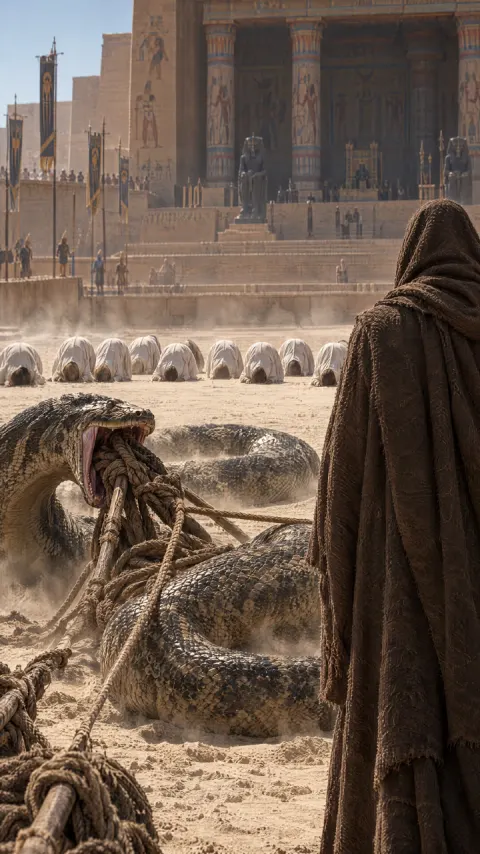
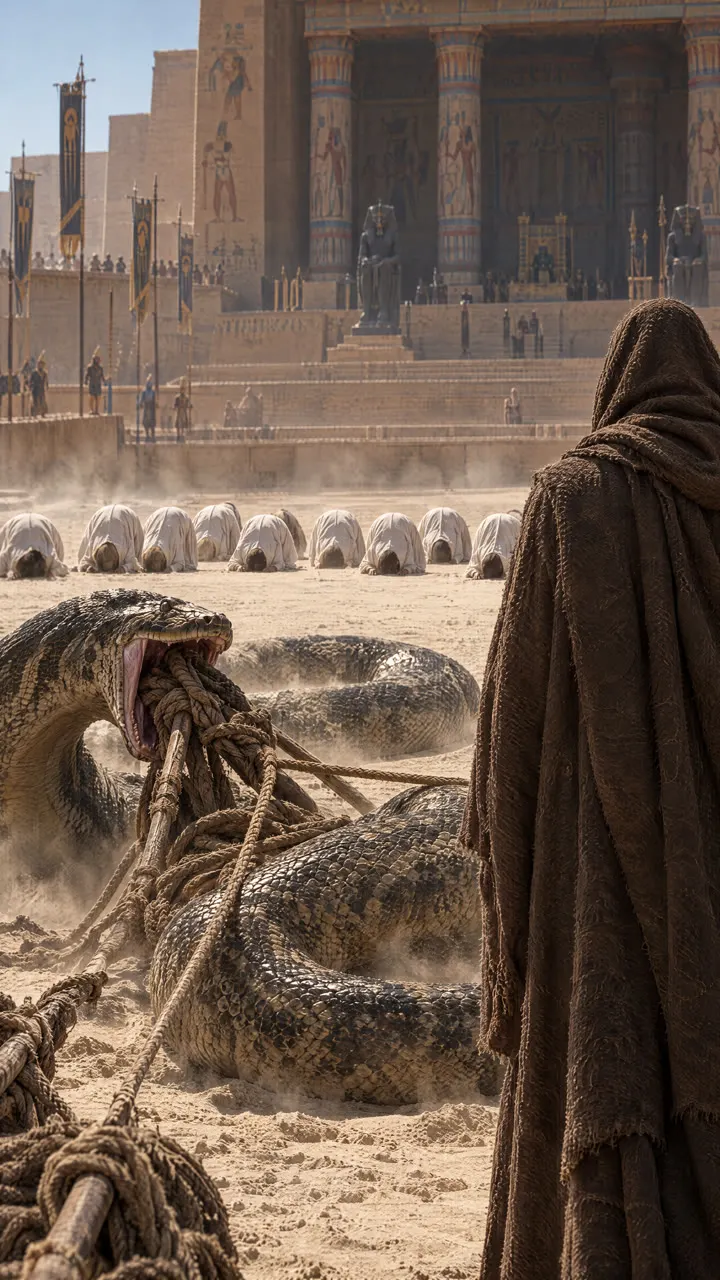
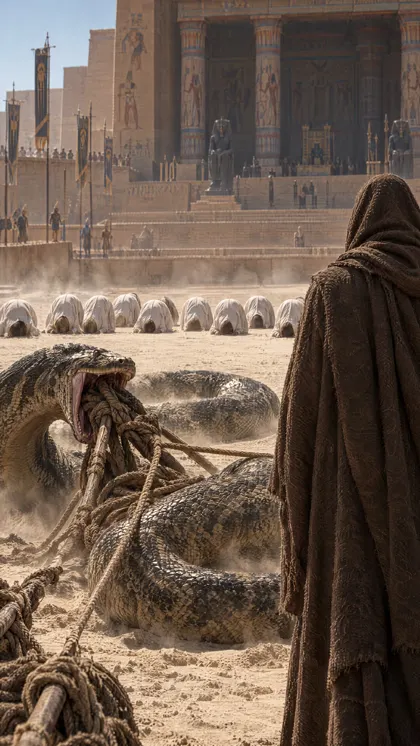
Al-Muyassar explains Pharaoh's words: did we not raise you in our homes as a child, and you stayed in our care for years of your life, and then you committed a crime by killing a man of my people when you struck him, and you are ungrateful for my favour? [[image EP27/01 "Years after the incident, Musa is back in Egypt as a messenger, seen from behind as his staff, now a great serpent, moves across the sand before Pharaoh's magicians"]]
Musa's reply, which we read above (26:20-21), admits the act, explains that it was before revelation, and moves straight to the message.
Al-Sa'di sums up the exchange well. Pharaoh's objection was that of someone ignorant, or pretending to be, because he made the killing a reason why Musa could not be a messenger. Musa showed him that the killing was an error with no intent to kill, and that Allah's favour is not withheld from anyone; so why should Pharaoh refuse what Allah had granted? As for the upbringing, Musa answers it in the next ayah: “And is this a favor of which you remind me - that you have enslaved the Children of Israel?”
(Quran 26:22)
Did the incident still weigh on Musa later?
Yes. When Allah called Musa at the valley and commanded him to go to Pharaoh, the killing was one of the first things he mentioned:
﴿قَالَ رَبِّ إِنِّى قَتَلْتُ مِنْهُمْ نَفْسًا فَأَخَافُ أَن يَقْتُلُونِ ٣٣ وَأَخِى هَـٰرُونُ هُوَ أَفْصَحُ مِنِّى لِسَانًا فَأَرْسِلْهُ مَعِىَ رِدْءًا يُصَدِّقُنِىٓ ۖ إِنِّىٓ أَخَافُ أَن يُكَذِّبُونِ ٣٤ قَالَ سَنَشُدُّ عَضُدَكَ بِأَخِيكَ وَنَجْعَلُ لَكُمَا سُلْطَـٰنًا فَلَا يَصِلُونَ إِلَيْكُمَا ۚ بِـَٔايَـٰتِنَآ أَنتُمَا وَمَنِ ٱتَّبَعَكُمَا ٱلْغَـٰلِبُونَ ٣٥﴾(33) He said, "My Lord, indeed I killed from among them someone, and I fear they will kill me. (34) And my brother Aaron is more fluent than me in tongue, so send him with me as support, verifying me. Indeed, I fear that they will deny me." (35) [Allāh] said, "We will strengthen your arm through your brother and grant you both supremacy so they will not reach you. [It will be] through Our signs; you and those who follow you will be the predominant."
Ibn Kathir explains that Musa had left Egypt fleeing from Pharaoh and fearing his power, so when he was sent back to him he said: I killed a man of them, and I fear they will kill me when they see me. Al-Sa'di describes this as Musa excusing himself to his Lord and asking for help, naming the obstacles he feared so that his Lord would remove them. And Allah did: He strengthened him with his brother Harun and promised “so they will not reach you”
(Quran 28:35).
The same request runs through Musa's famous du'a in Surah Taha, “My Lord, expand [i.e., relax] for me my breast [with assurance]”
(Quran 20:25), which we explain in Rabbi ishrah li sadri: the du'a of Musa.
"And you killed someone, but We saved you": Allah counts it among His favours
In Surah Taha, Allah lists His favours on Musa, and one of them is about this very incident: “And you killed someone, but We saved you from retaliation and tried you with a [severe] trial.”
(Quran 20:40)
﴿إِذْ تَمْشِىٓ أُخْتُكَ فَتَقُولُ هَلْ أَدُلُّكُمْ عَلَىٰ مَن يَكْفُلُهُۥ ۖ فَرَجَعْنَـٰكَ إِلَىٰٓ أُمِّكَ كَىْ تَقَرَّ عَيْنُهَا وَلَا تَحْزَنَ ۚ وَقَتَلْتَ نَفْسًا فَنَجَّيْنَـٰكَ مِنَ ٱلْغَمِّ وَفَتَنَّـٰكَ فُتُونًا ۚ فَلَبِثْتَ سِنِينَ فِىٓ أَهْلِ مَدْيَنَ ثُمَّ جِئْتَ عَلَىٰ قَدَرٍ يَـٰمُوسَىٰ ٤٠﴾(40) [And We favored you] when your sister went and said, 'Shall I direct you to someone who will be responsible for him?' So We restored you to your mother that she might be content and not grieve. And you killed someone, but We saved you from retaliation and tried you with a [severe] trial. And you remained [some] years among the people of Madyan. Then you came [here] at the decreed time, O Moses.
Al-Muyassar explains it: you killed the Coptic man by mistake, and We saved you from the distress of what you had done and from the fear of being killed, and We tested you with trials, so you left in fear for the people of Madyan and stayed among them for years. Al-Sa'di says Allah saved him from the grief of the punishment for the sin, and from being killed. Ibn Kathir explains the distress as what came over Musa when Pharaoh's people resolved to kill him, until he reached the water of Madyan and the righteous man there told him “Fear not. You have escaped from the wrongdoing people.”
(Quran 28:25)
So the Quran presents the whole episode as part of Allah's care for Musa: the mistake was forgiven, the danger was turned away, and the years in Madyan became the preparation for his message. Al-Sa'di closes his explanation of the ayah with “Then you came [here] at the decreed time, O Moses.”
(Quran 20:40): his arrival was not a coincidence but a time Allah had decreed.
The incident step by step
| Stage | What happens | Ayat |
|---|---|---|
| Maturity | Musa reaches full strength and is given wisdom and knowledge | 28:14 |
| The fight | He finds a man of his people and a man of Pharaoh's people fighting | 28:15 |
| The blow | He strikes once, and the man dies | 28:15 |
| Regret | "This is from the work of Satan" | 28:15 |
| Forgiveness | "My Lord, I have wronged myself", and Allah forgives him | 28:16 |
| The promise | "I will never be an assistant to the criminals" | 28:17 |
| The next day | Same man, a second fight; the killing becomes known | 28:18-19 |
| Warning and flight | A man runs to warn him; Musa leaves for Madyan | 28:20-22 |
| The calling | "I killed from among them someone, and I fear they will kill me" | 28:33-35 |
| Before Pharaoh | "I did it, then, while I was of those astray" | 26:18-22 |
| Allah's favour | "You killed someone, but We saved you" | 20:40 |
Lessons from the incident
- The Quran tells the truth about its prophets. It does not hide what happened to Musa, and it does not exaggerate it either. It gives the event, the intention, the regret and the forgiveness.
- Anger is a door for Satan. Musa himself called the blow Satan's work. Anger, even when it starts from wanting to help someone, can lead a person further than he meant to go.
- Admit it straight away. Musa's first words were
“indeed I have wronged myself”
(Quran 28:16). No excuse, no delay. - Allah forgives the one who turns back quickly. The forgiveness came in the same ayah as the request. Al-Sa'di says it is especially for those who hurry to repent.
- Turn forgiveness into a promise. Musa answered Allah's favour with a commitment never to help wrongdoing again (28:17). Al-Sa'di: blessings call for doing good and leaving evil.
- Do not take sides blindly. The next day Musa told the man of his own people
“Indeed, you are an evident, [persistent] deviator.”
(Quran 28:18) Belonging to your group does not make someone right. - A past mistake does not close the door to Allah's favour. Pharaoh tried to use the killing to deny Musa's message. Allah had already forgiven it and chosen Musa as a messenger.
- Allah can turn a hard moment into preparation. Fleeing Egypt took Musa to Madyan, and Madyan led him to the valley where he was called (20:40).
Is this incident an excuse for violence?
No, and the Quran makes sure it cannot be read that way. The man who did it called it “from the work of Satan”
(Quran 28:15), called himself a wrongdoer, asked forgiveness, and promised never to help wrongdoing again. Al-Tabari and al-Muyassar both explain his sin as killing a soul that Allah had not commanded him to kill. And the whole story is told in a surah that condemns the one who “was of the corrupters.”
(Quran 28:4)
If anything, the passage is a warning: even a good man, defending someone weaker, can do something he will regret for years if he acts in anger.
How to explain it to children
Keep it simple and true. Musa saw two men fighting, and one asked for his help. Musa was very strong. He hit the other man once to stop him, and the man died, which Musa never wanted. Musa felt very sorry at once, said it was Satan who made him angry, and asked Allah to forgive him, and Allah forgave him. Then Musa promised never to help anyone do wrong.
The lessons a child can carry: anger makes us do things we regret; when we do wrong, we say sorry to Allah right away; and Allah loves to forgive. For more ways to tell Musa's story to children, see the kids section of the story of Musa and Pharaoh.
Read and watch the story of Musa in QASAS
QASAS is a free prophet stories app with cinematic Quran stories you can watch or read page by page, each followed by a short quiz. The story of Musa and the magicians and the story of the parting of the sea are both in the app.
 Watch this story in QASASMusa and the MagiciansThe staff became a serpent and swallowed their tricks.Open on Google Play →
You can also open Surah al-Qasas in the app's full mushaf with recitation, read al-Muyassar and Ibn Kathir under each ayah, and see the translation and word-by-word meanings. The app also has prayer times, the qibla, adhkar and a 3D tasbih. It is free, with no ads and no account.
Frequently asked questions
Why did Prophet Musa kill the Egyptian man?
He did not set out to kill him. Musa found a man of his own people fighting a man of Pharaoh's people, the first called him for help, and Musa struck the other once, and he died (28:15). Al-Muyassar and al-Sa'di explain that it happened without intent and before his prophethood.
Did Musa mean to kill the man?
No. Al-Sa'di says Musa acted in anger without intending to kill, and that the killing was an error. Al-Muyassar describes it as "without intent" (26:20) and "by mistake" (20:40).
What does "this is from the work of Satan" mean in 28:15?
It means Satan stirred up Musa's anger until he struck. Al-Muyassar explains it this way, and al-Sa'di calls it Satan's adornment and whispering. Musa said it out of regret, and in the next ayah took the blame on himself: "indeed I have wronged myself".
Did Allah forgive Musa for killing the man?
Yes. Musa said "My Lord, indeed I have wronged myself, so forgive me", and the same ayah says "and He forgave him" (28:16). Al-Tabari explains that Allah pardoned him and did not punish him for it.
Was Musa a prophet when he killed the man?
No. Al-Muyassar states that it happened before his prophethood. Musa told Pharaoh "I did it, then, while I was of those astray" (26:20), which al-Tabari and Ibn Kathir explain as before revelation came to him.
Who said "do you intend to kill me as you killed someone yesterday"?
The tafsir differ. Ibn Kathir says it was the man of the Children of Israel, who thought Musa was about to strike him, and the secret came out that way. Al-Sa'di says it was the Copt, warning Musa off, and that Musa held back.
Why did Musa run away to Madyan?
Because Pharaoh's chiefs were plotting to kill him for the killing, and a man came running from the far end of the city to warn him (28:20). He left Egypt alone, praying "My Lord, save me from the wrongdoing people" (28:21).
Does the Quran say what the Egyptian man's name was?
No. The Quran only says he was "from among his enemy", which Ibn Kathir and al-Sa'di explain as one of the Copts, Pharaoh's people. His name, and the reason for the fight, are not given, and the lesson does not depend on them.
Sources
The Quran: Surah al-Qasas 28:4, 28:14-22, 28:24-25, 28:30, 28:33-35; Surah ash-Shu'ara 26:18-22; Surah Taha 20:25, 20:40. Tafsir: al-Tafsir al-Muyassar (King Fahd Complex), Tafsir Ibn Kathir, Tafsir al-Tabari (Jami' al-Bayan), and Tafsir al-Sa'di (Taysir al-Karim al-Rahman), on the same ayat.
Updated: · By QASAS